Compliance
Beyond Checklists: How Compliance Automation Tools Support SEC-Ready RIAs in 2026
Vinamrata Yadav
5 mins

Compliance
See how compliance automation tools enable RIAs to automate supervision, improve audit readiness, and build a more resilient compliance program.
If you're leading compliance today, the challenge isn't understanding the rules. It's proving, every day, that your supervisory controls are operating as intended. Between the SEC's amended Regulation S-P, continued scrutiny of the SEC Marketing Rule compliance, and rising expectations around supervisory effectiveness, the burden of evidence has never been higher.
We understand that expanding oversight rarely comes with expanding resources. That's why periodic reviews and static checklists are giving way to continuous compliance.
In this article, we'll explore how compliance automation tools help RIAs strengthen supervisory controls, improve regulatory defensibility, and remain SEC-ready in 2026.
Brief look:
Manual compliance is eroding supervisory effectiveness. The result is a growing gap between documented controls and demonstrable oversight.
"Over the last few years, increased regulatory expectations and demands have greatly increased the focus and scrutiny on traditional marketing compliance review processes." — EY, Next-Generation Marketing Compliance and Oversight
For many RIAs, those pressures manifest across everyday compliance operations:
Compliance records are dispersed across CRM platforms, email archives, portfolio management systems, document repositories, and vendor portals, making it difficult to establish a complete audit trail.
Risks are often identified during periodic reviews or examination preparation instead of through continuous surveillance and timely escalation.
Skilled compliance professionals spend valuable time collecting documentation, validating disclosures, and reconciling records rather than investigating high-risk exceptions.
These challenges expose the limits of checklist-driven compliance. As supervisory expectations continue to change, compliance automation tools have become a strategic requirement. They enable RIAs to move from reactive reviews to continuous, evidence-based oversight.
Glynac helps RIAs eliminate fragmented workflows, strengthen supervisory controls, and replace reactive reviews with continuous, intelligence-driven compliance. Request early access to see how your compliance team can reduce operational complexity while staying SEC-ready.
The value of compliance automation is measured by its ability to strengthen supervisory controls where regulatory exposure is highest.
The following areas consistently deliver the greatest operational and compliance impact:
| Operational Area | Manual Compliance Challenge | Regulatory Impact |
|---|---|---|
| Marketing Rule Supervision | Manual review delays approvals and increases oversight gaps across advisor communications. | Supports continuous compliance with SEC Rule 206(4)-1 (Marketing Rule). |
| Billing & Fee Oversight | Periodic reconciliations delay detection of billing discrepancies. | Strengthens compliance with the Investment Advisers Act fiduciary obligations. |
| Customer Data & Incident Response | Disconnected workflows hinder incident response and documentation. | Improves governance under the SEC's amended Regulation S-P. |
| Client Complaint Management | Complaint records remain fragmented across multiple systems. | Supports SEC Books and Records Rule 204-2 with centralized audit trails. |
The business value extends beyond operational efficiency:
These capabilities become more meaningful when applied to real-world compliance workflows. Let's examine the most impactful use cases of compliance software tools across wealth management operations.
Suggested Read: Compliance Software: How to Choose the Right Platform for Your Business in 2026
Compliance automation is already delivering measurable value across financial services. While implementation priorities vary by organization, leading firms are using automation to strengthen supervisory controls, standardize compliance workflows, and improve examination readiness.
Top industry use case studies include:
A U.S.-based hedge fund managing more than $12 billion in assets replaced fragmented compliance processes spanning employee trading, marketing reviews, electronic communications, and regulatory reporting with a centralized compliance platform.
The change standardized supervisory workflows, reduced operational complexity, and improved visibility across the compliance function.
Outcome:
A global financial institution modernized its anti-money laundering (AML) compliance program after manual monitoring and disconnected systems limited operational efficiency.
By implementing automated workflows, centralized case management, and advanced analytics, the organization strengthened monitoring, investigations, and governance across its compliance operations.
Outcome:
As regulatory complexity and data volumes continue to grow, the next frontier lies in combining automation with AI-powered governance.
Automation executes predefined controls. AI extends those controls by analyzing large volumes of structured and unstructured data, identifying emerging risk patterns, and helping compliance teams prioritize high-impact investigations.
AI is delivering measurable value across several areas of the compliance function:
The greatest value of AI is realized when it is embedded within a purpose-built compliance platform rather than deployed as a standalone capability. That is the approach Glynac takes.
Suggested Read: Compliance Monitoring Tools: Six Key Features to Look for Before You Buy
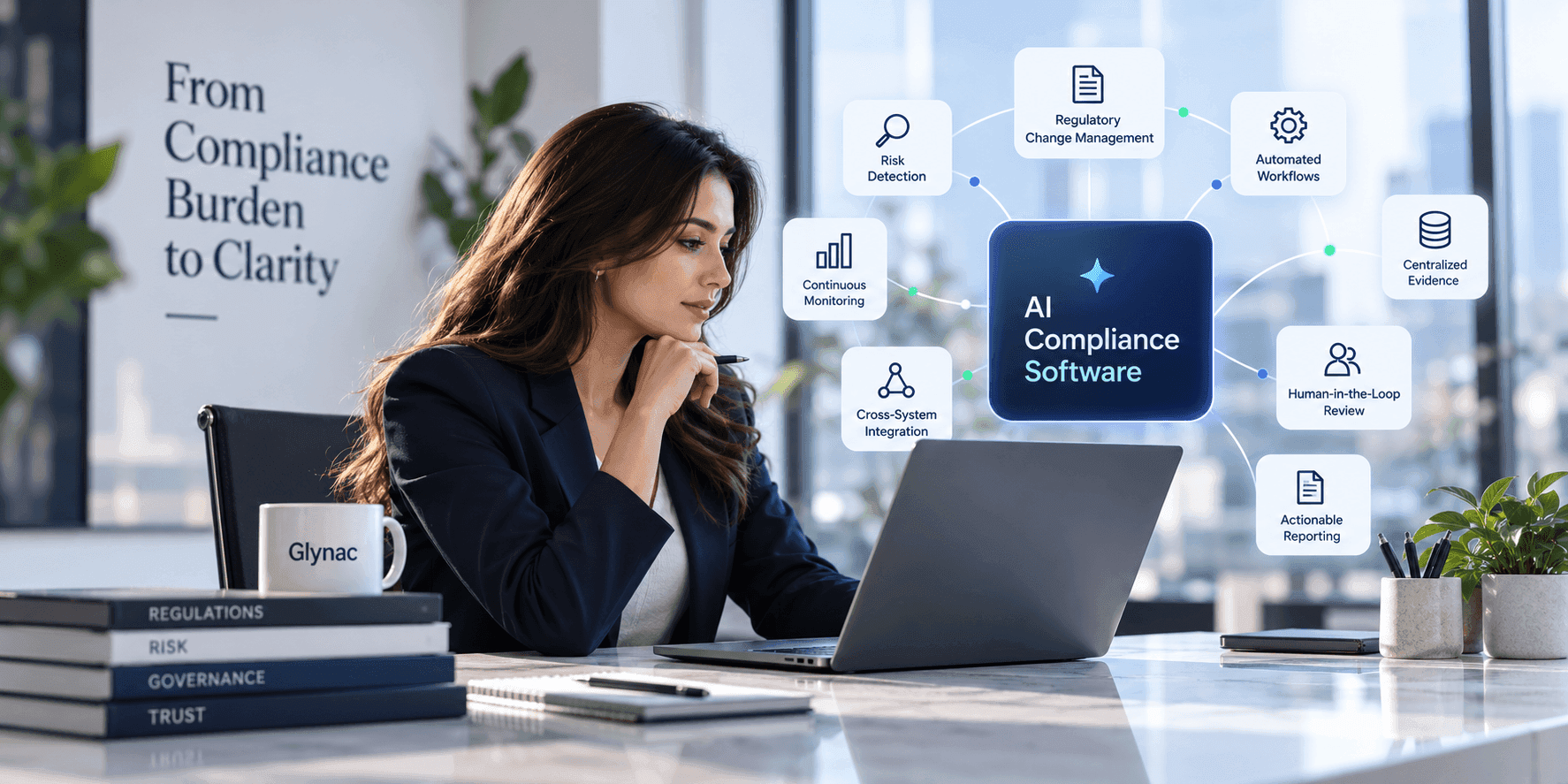
Glynac is an AI-powered compliance intelligence platform purpose-built for wealth management firms. Rather than replacing your existing technology stack, it integrates with your CRM, portfolio management platforms, custodians, email, and messaging systems to create a unified compliance workspace.
It combines AI with continuous compliance monitoring, centralized intelligence, and automated supervisory workflows to help RIAs build a more proactive, SEC-ready compliance function.
Here's how Glynac strengthens modern compliance operations:
The result is a compliance function that spends less time chasing evidence and more time managing risk.
Firms using our platform have reported up to a 70% reduction in manual evidence gathering, up to a 90% reduction in false-positive alerts, and pre-audit preparation reduced from weeks to days. That's the difference between proving compliance after the fact and demonstrating it continuously.
Regulatory expectations will continue to evolve, but manual compliance cannot scale at the same pace. Delayed risk detection, fragmented evidence, and inconsistent oversight increase both regulatory and operational exposure. The longer firms rely on reactive processes, the wider the compliance gap becomes.
Glynac helps RIAs modernize supervisory operations with continuous compliance intelligence built specifically for wealth management. It enables compliance teams to strengthen oversight, improve regulatory defensibility, and operate with greater confidence.
Build a compliance program that's prepared for the next examination and not just the next audit request. Get in touch with us to see how AI-powered compliance intelligence improves supervisory operations.
Compliance automation tools help RIAs automate repetitive compliance activities such as surveillance, evidence collection, workflow management, and regulatory reporting. Rather than replacing compliance professionals, they improve supervisory consistency, reduce manual effort, and enable continuous monitoring across high-risk areas such as marketing, billing, and client communications.
Startup compliance software is typically designed for organizations with simpler regulatory requirements and limited operational complexity. RIAs and outsourced compliance firms often require purpose-built platforms that support SEC regulations, supervisory workflows, audit readiness, and integrations with wealth management systems as compliance programs mature.
Security compliance helps firms protect sensitive client information while meeting regulatory obligations related to data governance, cybersecurity, and incident response. With the SEC's amended Regulation S-P placing greater emphasis on safeguarding customer information, maintaining strong security controls has become an essential component of an effective compliance program.
AI governance establishes the policies, controls, and oversight needed to ensure artificial intelligence is used responsibly within regulated environments. For compliance teams, this includes validating AI-generated outputs, maintaining human oversight, documenting decision-making processes, and ensuring AI supports—not replaces—professional judgment.
A compliance software tool should support continuous monitoring, centralized evidence management, automated workflows, and seamless integration with existing wealth management systems. Compliance leaders should also evaluate scalability, audit readiness, regulatory coverage, and the platform's ability to adapt as supervisory requirements evolve.
Vinamrata Yadav
Content Strategist
Vinamrata Yadav is a financial content writer with a focus on investment management, portfolio strategy, and market trends. She creates evidence-based content that simplifies complex financial topics while maintaining the depth expected by experienced investors and wealth professionals. Her writing bridges technical expertise with practical application.
Continue exploring insights on wealth management
Compliance
Plenty of platforms carry the AI label; fewer can tell you why they flagged something. Here are the 10 features that separate modern AI compliance software from expensive filing, from source traceability and human-in-the-loop review to remediation you can actually verify.
Nirmala Royal
Marketing Research Assistant

Compliance
The audit itself isn't what wears compliance officers down—it's the fortnight before, spent digging out approvals and reconstructing who cleared what. Here's how compliance audit management software keeps evidence, ownership and monitoring running year-round, plus seven best practices for 2026.
Nirmala Royal
Marketing Research Assistant

Compliance
Discover AI compliance use cases that help RIAs strengthen compliance workflows, improve regulatory automation, and build effective AI risk management in 2026.
Vinamrata Yadav
Content Strategist