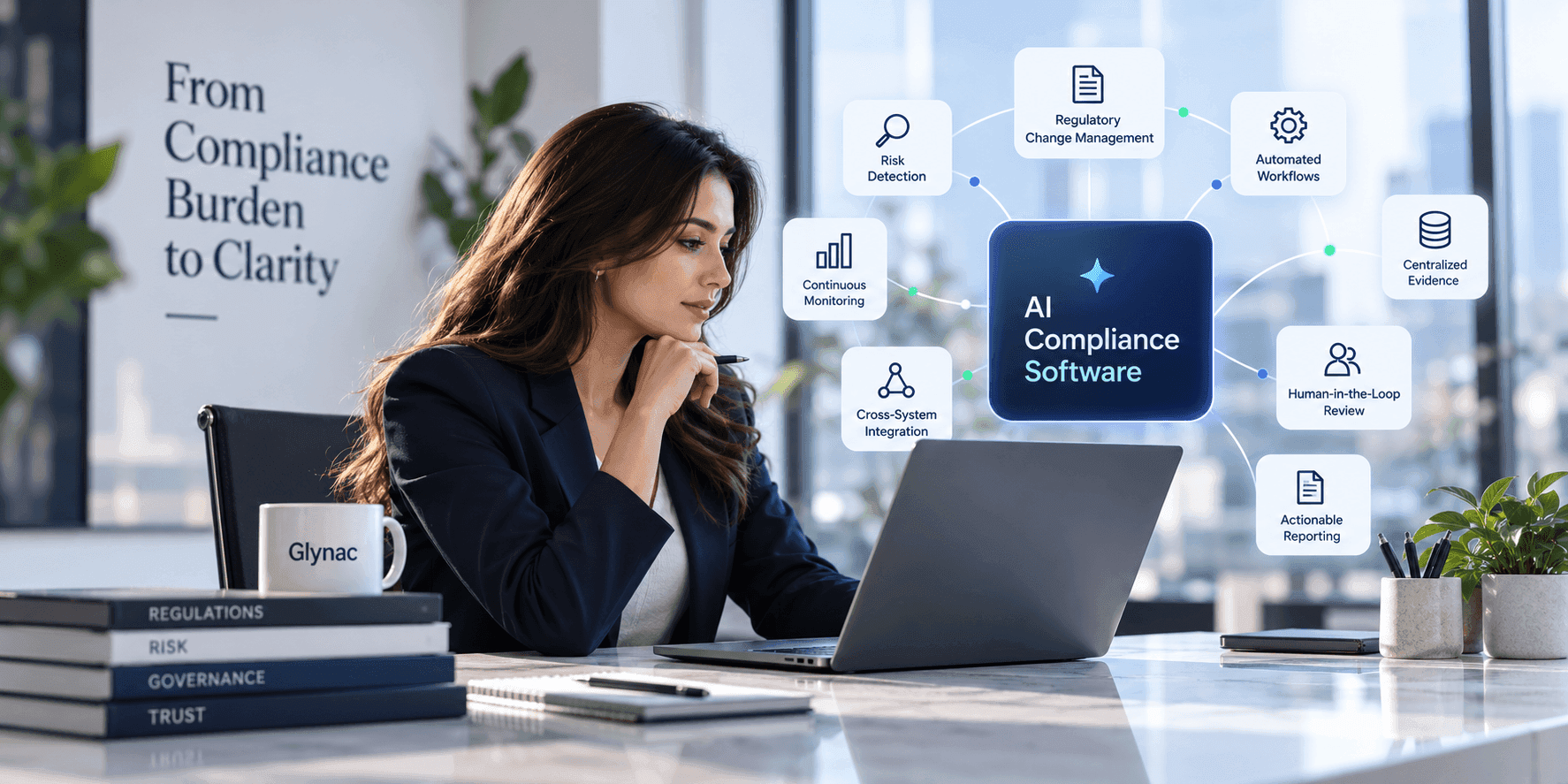
Plenty of platforms carry the AI label; fewer can tell you why they flagged something. Here are the 10 features that separate modern AI compliance software from expensive filing, from source traceability and human-in-the-loop review to remediation you can actually verify.
Every compliance team has the same complaint right now: more data from more places, more rules to map it against, and less patience from examiners for "let me go and find that." Add AI into the business itself, sitting inside marketing tools and client comms and portfolio analytics, and you have a supervision problem nobody's control framework was drawn up for.
That's the gap AI compliance software is meant to close. CUBE's Cost of Compliance Report 2025 found 98% of firms have adopted automation somewhere in their compliance function, though very few have anything approaching end-to-end visibility, which is a fairly precise description of the problem.
Plenty of platforms carry the AI label. Fewer can tell you why they flagged something.
What Is AI Compliance Software?
It's software that uses machine learning, automation and workflow tooling to monitor compliance activity, spot potential risk, hold evidence together, and get findings in front of the right person. Older compliance systems mostly tracked tasks and stored documents. The newer generation reads across sources and surfaces the things that look wrong.
Where firms typically point it:
- Compliance monitoring and communications review
- Risk detection across transactions and activity
- Regulatory change management
- Document analysis, evidence management, audit prep
- Workflow automation
- AI governance (increasingly its own category of work)
- Investigation and timeline reconstruction
None of this is meant to replace compliance professionals. It's meant to stop them spending Thursday afternoon collating attachments.
10 Essential Features of Modern AI Compliance Software
-
Risk detection that prioritizes rather than shouts. Unusual transactions, missing approvals, policy exceptions, records that contradict each other, communication patterns worth a second read. A system that labels things "non-compliant" on its own is overreaching. One that ranks what a qualified reviewer should look at first is doing the job.
-
Continuous or risk-weighted monitoring. Annual review cycles find problems months after they happened. Watching control performance, attestations, exceptions and open actions as they move means you catch things while the context is still fresh and the fix is still cheap.
-
Automated workflows. Review assignment, evidence requests, deadline reminders, approval routing, escalation when something goes overdue, report generation. All of it runs without a person. What happens in the middle, the actual decision, shouldn't.
-
Centralized evidence and audit trails. Compliance information hides in email, CRM, shared drives, chat, portfolio systems and roughly four spreadsheets. Good AI compliance tools pull the pieces together and record what happened, when, who did it, what they reviewed, what they decided, what followed.
-
Source traceability. "Potential compliance issue detected" is not a finding, it's a chore. A reviewer needs to know what triggered it, which data was analyzed, which policy applies, and what to go and check. Traceability back to source is the single feature that decides whether AI output is usable in a regulated environment.
-
Human-in-the-loop review. The tool identifies and explains. A person reviews, judges materiality, decides, and the system writes the sequence down. NIST's AI Risk Management Framework puts it plainly:
"Trustworthy AI depends upon accountability. Accountability presupposes transparency."
-
Regulatory change management. Receiving the update is not the same as implementing it. Every change needs somebody to work out whether it applies, which policy it touches, which control has to change, who owns it, and what evidence proves it's done. AI regulatory compliance features earn their keep when they convert an update into assigned work.
-
Cross-system integration. Risk often becomes visible only when two sources are read together. A message that looks innocuous alone reads differently beside a transaction record and an approval that never happened. Hence connecting CRM, email, portfolio systems, document stores and HR data instead of reviewing each in isolation.
-
Risk, control and remediation in one chain. Reporting that "ten findings were closed" tells leadership nothing. Which risks, which controls failed, who fixed them, was the control retested. Compliance automation tools that track findings through to verified closure make that answerable.
-
Reporting that points somewhere. Compliance staff need open findings, overdue actions, upcoming reviews. Leadership needs posture, trends and whether remediation is actually moving. Two audiences, two views, and neither is served by a wall of charts.
What to Prioritize When You're Evaluating
Bring a real scenario to the demo. Something that went wrong last year, not the vendor's sample data.
| Feature | The question to ask |
|---|---|
| Risk detection | Does it find meaningful risk, or generate alert fatigue? |
| Monitoring | Can we watch what matters between reviews? |
| Automation | What runs when a review goes five days overdue? |
| Audit trails | Can you export one control's full history, unedited? |
| Explainability | Show me why this alert fired |
| Human review | Where is sign-off enforced? |
| Regulatory intelligence | Does an update become a task with an owner? |
| Integrations | Which of our systems are live in production today? |
| Remediation | Can findings be assigned, tracked and verified? |
| Reporting | Can leadership see what needs attention in a minute? |
The strongest platform isn't the one with the most AI in the deck. It's the one that fits how your team already works and makes oversight quicker to defend.
How Glynac Fits In
Glynac is built as an AI compliance intelligence and oversight layer for wealth management firms and RIAs. The assumption is that you already own most of the systems you need and what's missing is the connective tissue between them.
Firms use AI compliance management software like this to surface anomalies worth investigating, review communications and documents at volume, rebuild timelines without manual digging, tie every finding back to its source record, and end up with audit trails that accumulated rather than being assembled. It's most useful where the stack is already crowded but nothing talks to anything else.
Want to see how it handles your environment? Talk to the Glynac team.
Conclusion
The useful test for AI compliance software isn't how much it automates. It's whether a reviewer can look at any finding and understand where it came from, whether the decision that followed is recorded, and whether you could walk an examiner through both without preparation.
Firms that get this right don't have fewer obligations than anyone else. They spend less of the week proving they met them, which frees up the part of the job that needs a human in the chair.
FAQs
What is AI compliance software?
Software that applies machine learning, automation and data analysis to compliance monitoring, risk detection, evidence management and review workflows, with humans still making the calls.
Can it replace compliance teams?
No. It removes repetitive work and narrows where attention goes. Judgment, materiality decisions and accountability stay with qualified people.
Why does explainable AI matter here?
Because you have to defend the decision later. If nobody can say why a finding was raised, it can't be validated, documented or explained to a regulator.
Is it useful for RIAs specifically?
Yes, particularly for communications review, supervision, evidence collection and audit prep, where the volume is high and the record-keeping expectations are exacting.
Nirmala Royal
Marketing Research Assistant
Marketing research and content professional with a focus on SEO, industry research, and creating clear, research-driven content that helps businesses understand emerging trends and technologies.
Related Blogs
Continue exploring insights on wealth management

Compliance
Compliance Audit Management Software: Best Practices for 2026
The audit itself isn't what wears compliance officers down—it's the fortnight before, spent digging out approvals and reconstructing who cleared what. Here's how compliance audit management software keeps evidence, ownership and monitoring running year-round, plus seven best practices for 2026.
Nirmala Royal
Marketing Research Assistant

Compliance
7 AI Compliance Use Cases Every RIA Should Prioritize in 2026
Discover AI compliance use cases that help RIAs strengthen compliance workflows, improve regulatory automation, and build effective AI risk management in 2026.
Vinamrata Yadav
Content Strategist

Compliance
Beyond Checklists: How Compliance Automation Tools Support SEC-Ready RIAs in 2026
See how compliance automation tools enable RIAs to automate supervision, improve audit readiness, and build a more resilient compliance program.
Vinamrata Yadav
Content Strategist