AI in Wealth Management
Best RIA Compliance Software: 8 Platforms Compared (2026)
Nirmala Royal
5 mins

AI in Wealth Management
Picking the best RIA compliance software in 2026 comes down to fit, not feature lists. Here are 8 top RIA compliance platforms compared, along with a framework covering coverage, automation depth, integrations, and audit readiness to help you choose.
Picking the best RIA compliance software 2026 has less to do with feature lists than most vendor decks suggest. What a registered investment adviser actually needs is technology that carries regulatory obligations, employee supervision, communications, marketing review, risk assessments, recordkeeping and examination evidence without becoming another thing the compliance team has to administer.
The timing pressure is real. CUBE's Cost of Compliance Report 2025 found 74% of firms take more than a year to implement a new regulation, a lag that usually traces back to information sitting somewhere nobody can query rather than to any shortage of effort.
Below are eight of the top RIA compliance platforms worth shortlisting in 2026, and an honest read on where each one fits.
Agree the baseline internally before you sit through demos. Most credible platforms cover some mix of:
None of it moves the underlying obligation anywhere. The rule is direct about that:
"Adopt and implement written policies and procedures reasonably designed to prevent violation... Review, no less frequently than annually, the adequacy of the policies and procedures established pursuant to this section and the effectiveness of their implementation." SEC Rule 206(4)-7, Compliance procedures and practices
So the software has to show not just that policies exist, but that they are being implemented and reviewed.
| Platform | Best for | Key strength |
|---|---|---|
| Glynac | AI-driven RIA oversight | Connected compliance intelligence |
| Comply | Full-service program management | Workflows plus expert services |
| Smartria | RIA-focused program management | Configurable compliance automation |
| Hadrius | AI-powered supervision | Continuous monitoring and testing |
| Greenboard | Unified compliance operations | Archiving, marketing, trading, employees |
| Red Oak | Marketing compliance | Advertising review and workflow automation |
| ACA ComplianceAlpha | Enterprise programs | Compliance, risk and surveillance at scale |
| StarCompliance | Employee compliance | Personal trading and conflicts |
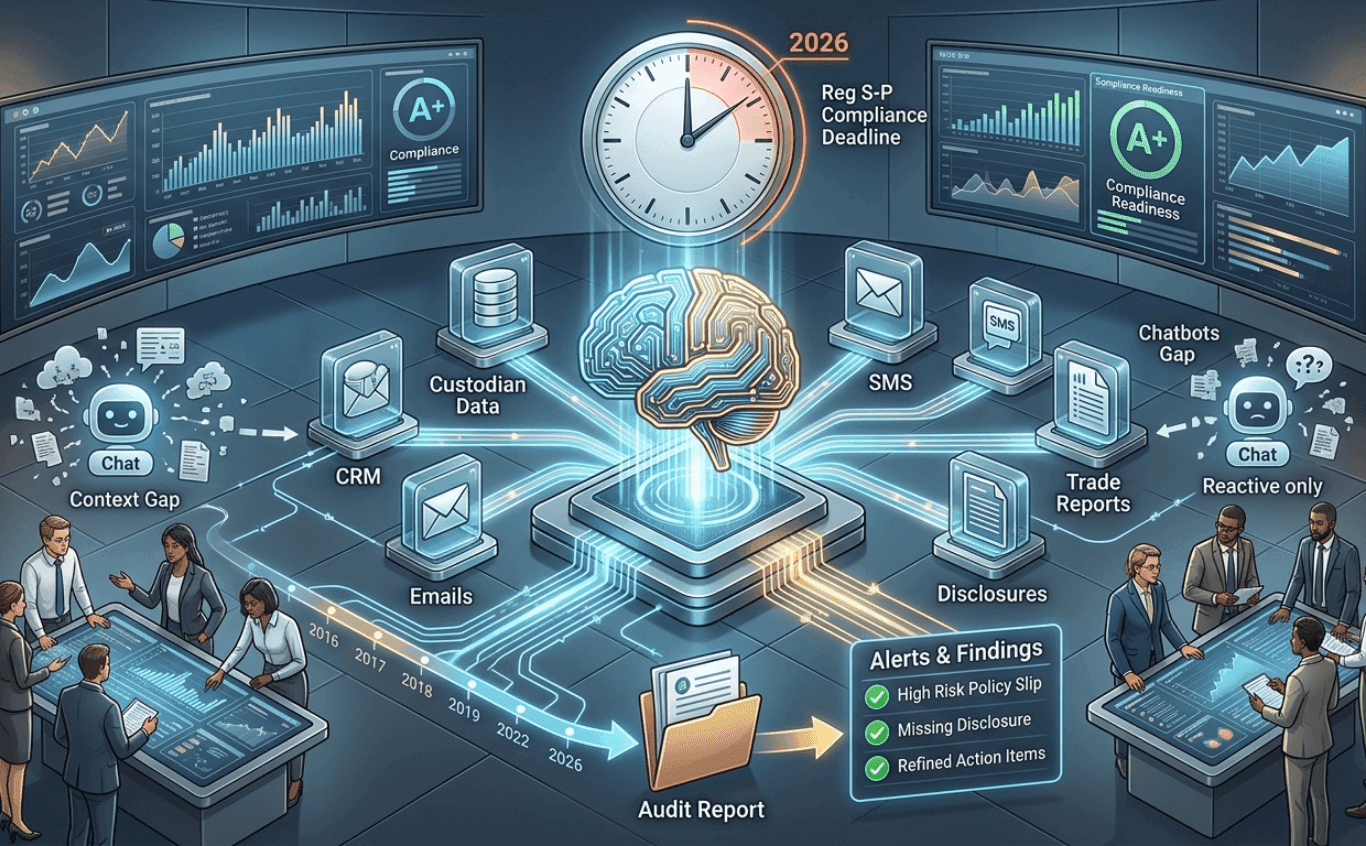
Glynac. Works as an AI compliance intelligence layer rather than a task or documentation system. It connects CRM, portfolio systems, email, messaging and filings so a reviewer can investigate with the surrounding context attached, then handles anomaly detection, communications and marketing review, timeline reconstruction and evidence gathering with a human signing off. Among RIA compliance management software options, it is aimed at firms that already own plenty of systems and lack anything connecting them.
Comply. Broad coverage plus services: compliance calendars and logs, SEC and state registration, Form ADV workflows, annual reviews, risk assessments, employee supervision, personal trading, archiving, cybersecurity, IAR registration and CE. Useful when you want the technology and the consulting from one provider.
Smartria. Purpose-built around RIA compliance rather than adapted from a general financial-services platform. Automated tasks and reminders, marketing reviews, attestations, personal trading, vendor management, audit-ready documentation, with workflows configurable enough to survive growth from boutique to enterprise.
Hadrius. AI applied to testing, supervision and continuous monitoring across trading, marketing, communications and employee activity. Suited to firms drowning in high-volume supervisory review rather than firms struggling to track tasks.
Greenboard. An AI-powered compliance operating system pulling communications archiving, marketing review, trade monitoring, employee oversight, WORM recordkeeping and broker integrations into one place. The appeal is consolidation, plainly.
Red Oak. The specialist where marketing volume dominates the workload. Advertising review, approvals, disclosure and registration management, configurable workflows, document stamping, audit trails, AI-assisted review. Depth here beats breadth elsewhere if that is your bottleneck.
ACA ComplianceAlpha. Enterprise RegTech spanning compliance management, risk monitoring, marketing review, employee compliance, eComms, surveillance, AML/KYC, cybersecurity, training and analytics, tied into ACA's wider ecosystem. Built for complex regulatory structures.
StarCompliance. Deep on employee conduct and conflicts: pre-clearance, trade surveillance, attestations, outside business activities, gifts and hospitality, political activity, private investments, case management, with a rules engine driving approval and escalation.
These overlap less than the category pages imply. Running a core platform alongside one specialist is common and perfectly defensible.
Older systems organise tasks, documents and deadlines. Newer ones help interpret what is in them: communication surveillance, marketing review, anomaly detection, document comparison, risk prioritisation, investigation support.
The sequence that survives an examination does not vary by vendor. The tool identifies and explains, a person reviews, that person decides, the system records all of it. NIST's AI Risk Management Framework lands on the same point: trustworthy AI depends on accountability, and accountability presupposes transparency. A platform that flags something without showing its working has added verification work, not removed it.
For the wider context, see our take on the compliance pressures pushing RIAs toward automation and the current field of AI compliance software for RIA firms.
No single platform wins for every firm. Glynac suits firms wanting AI-driven compliance intelligence, Comply and Smartria cover broad program management, Hadrius leans into AI supervision, and Red Oak and StarCompliance are specialists.
Compliance calendars, policies, annual reviews, risk assessments, employee supervision, personal trading, marketing review, communications, filings, recordkeeping and audit documentation.
No. Rule 206(4)-7 requires a designated individual administering the program. AI is decision support and workflow automation underneath that person.
Almost all vendors price on firm size, users, modules, integrations and services rather than publishing list pricing, so budget for a scoping conversation.
The best RIA compliance software 2026 is the platform that fits your obligations, connects to your existing technology, cuts manual work, and produces evidence you would be comfortable putting in front of an examiner. Feature counts are a poor proxy for all four.
Comply and Smartria for broad program management. Hadrius and Greenboard for AI-driven supervision. Red Oak for marketing volume. ACA for enterprise complexity. StarCompliance for employee trading and conflicts. Glynac for firms moving from fragmented workflows toward connected, intelligence-driven oversight.
Want to see how that last one holds up against your own environment? Talk to the Glynac team and bring a real scenario rather than a demo dataset.
Nirmala Royal
Marketing Research Assistant
Marketing research and content professional with a focus on SEO, industry research, and creating clear, research-driven content that helps businesses understand emerging trends and technologies.
Continue exploring insights on wealth management

AI in Wealth Management
Compliance at an RIA runs continuously now, spread across systems that do not speak to one another. Here are the 8 best compliance procedure automation tools for RIAs in 2026, compared by what each does best, plus five questions to help you choose the right fit.
Nirmala Royal
Marketing Research Assistant

AI in Wealth Management
Compliance at an RIA stopped being an annual event, it now runs continuously, across systems that were never introduced to each other. Here are 8 RIA compliance platforms compared by what each is actually good at, plus how to choose the one that fits your firm.
Nirmala Royal
Marketing Research Assistant
AI in Wealth Management
Discover how Glynac AI differs from generic AI tools for RIA compliance automation by delivering audit-ready workflows, centralized compliance intelligence, scalable oversight, and explainable AI built specifically for wealth management firms.
Rahul Sinha
Marketing Consultant