AI in Wealth Management
Best Platforms for RIAs to Vet Vendor AI Tools for SEC Compliance
Nirmala Royal
5 mins
AI in Wealth Management
The best platforms for RIAs to vet vendor AI tools for SEC compliance, and what a defensible vendor review actually needs to show.
AI has arrived in the RIA stack sideways. Not usually as a deliberate purchase, but as a feature switched on inside a CRM you bought four years ago, a meeting summariser someone enabled on a trial, a marketing tool that quietly started reading client records. Advisor360°'s 2026 Connected Wealth Report found 90% of advisers are interested in using AI to widen what they offer, which tells you how fast this is moving.
Which is why the best platforms for RIAs to vet vendor AI tools for SEC compliance have become a genuine line item rather than a nice-to-have. Amended Regulation S-P now carries a hard 30-day customer notification deadline after unauthorised access, and it puts service-provider oversight squarely on the firm.
Worth saying plainly up front: no software can declare a vendor "SEC compliant." That judgment is yours. What good tooling does is help you evaluate, document, monitor and evidence it.
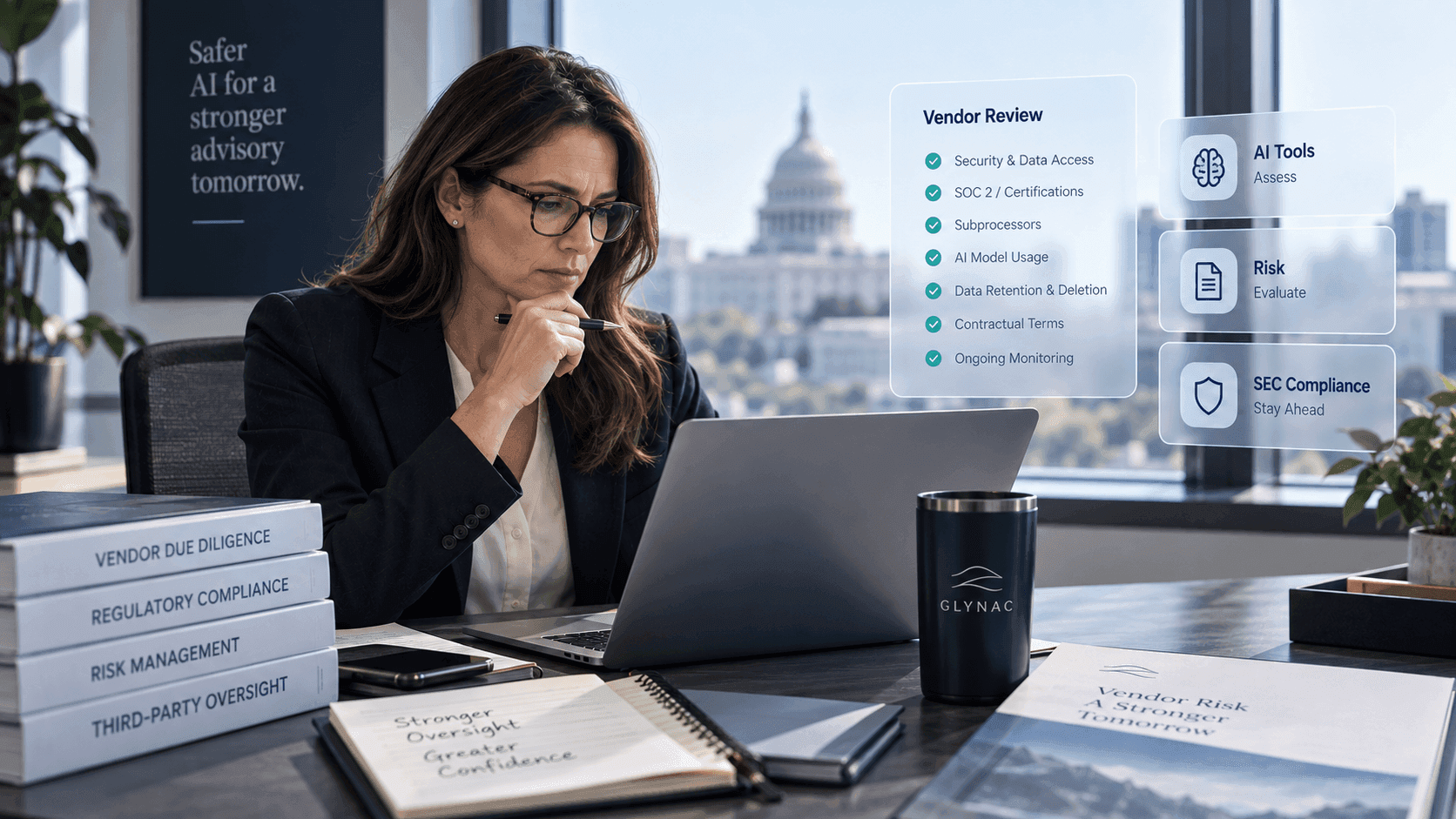
Most of a defensible review comes down to knowing what the tool touches and who else sees it:
SOC 2 reports, contractual protections and security certifications belong in the file too. Collecting a SOC 2 is not the same as reviewing it, and only one of those two things is evidence.
| Platform | Primary focus | Useful for |
|---|---|---|
| RegFin | RIA compliance and vendor due diligence | Vendor records, DDQs, SOC 2 tracking, risk scoring |
| COMPLY | RIA compliance and cybersecurity | Third-party due diligence and risk assessment |
| Redan | Vendor due diligence | DDQs, risk classification, renewal tracking |
| NobleCloak | AI vendor risk | AI discovery, data access, Reg S-P oversight |
| BlackSheep | Cybersecurity compliance | Vendor obligations, controls, evidence |
| Glynac | AI compliance intelligence | Continuous monitoring and connected risk data |
RegFin puts vendor due diligence inside a broader RIA compliance platform: vendor records, questionnaires, SOC 2 documentation, contract details, risk scoring, renewal tracking. Sensible when you want oversight sitting alongside the rest of the program rather than running as its own process in a separate spreadsheet.
COMPLY covers annual reviews, risk assessments, employee supervision and cybersecurity workflows, with third-party due diligence built specifically around technology vendors RIAs actually use. Parts of the review and documentation cycle can be automated with supported vendors.
Redan narrows to vendor oversight: questionnaires, risk classification, document collection, expiration tracking, and a documented record of the CCO's review and determination. That last piece matters more than it sounds.
NobleCloak is built around AI vendor risk for RIAs and broker-dealers. It starts from discovery, finding which AI tools are actually in use across the firm and what they can reach. Useful precisely because traditional vendor inventories miss the assistant a vendor added last quarter.
BlackSheep approaches this through cybersecurity, mapping controls and evidence to requirements including Reg S-P, with vendor oversight, incident management and evidence collection. The right frame when your AI review is really a customer-information review.
Glynac treats vendor risk as continuous rather than annual. Its AI compliance intelligence layer connects information across your existing systems to support vendor monitoring, investigation and evidence gathering, which helps surface relationships that are hard to see when vendor data lives across spreadsheets, inboxes and three unrelated platforms. Our piece on the hidden compliance risk in your vendor stack covers why that fragmentation is the actual problem.
A completed questionnaire is not a review. What holds up shows who the vendor is, what data it reaches, why the firm needs it, which controls and contractual protections were examined, what risks surfaced, what was decided, who approved it, when the next review falls due, and what triggers an earlier one.
The rule is explicit that oversight continues after signature:
"...written policies and procedures reasonably designed to require oversight, including through due diligence and monitoring, of service providers..." Regulation S-P, 17 CFR 248.30
Due diligence and monitoring, as two separate obligations. An approval from eighteen months ago, with nothing since, satisfies the first and not the second.
Automation genuinely speeds this up. AI can extract findings from SOC 2 reports, compare this year's documentation against last year's, spot missing evidence, classify vendors by risk, track renewals, flag changes in security posture and surface which vendors touch sensitive information.
What it should not do is conclude that a vendor is acceptable because the checklist filled in. The workflow that survives scrutiny keeps those separate: the tool identifies, compliance reviews, the CCO decides, the system records all of it. For more on where automation earns its place, see our rundown of AI compliance use cases every RIA should prioritise.
No. There is no mandated product. The obligation is to maintain appropriate safeguarding and oversight processes and to be able to evidence them.
Rarely. Check the report's scope and findings, then weigh them against the tool's data access, contractual terms, AI practices and your own exposure. Scope is where most SOC 2 reports disappoint.
Risk-based. A tool reading client communications warrants far more attention than a scheduling utility. Tie frequency to data sensitivity rather than to the calendar.
Partly. Document analysis, evidence collection, risk classification, monitoring and workflow, yes. The assessment and approval stay with a qualified person.
The best platforms for RIAs to vet vendor AI tools for SEC compliance are not the ones with the longest AI feature list. They are the ones that help you understand what a vendor touches, record why you approved it, notice when that changes, and produce evidence of ongoing oversight when someone asks.
RegFin and COMPLY fold due diligence into a broader compliance program. Redan focuses on structured vendor review. NobleCloak specialises in discovering AI tools already inside the firm. BlackSheep works the cybersecurity and Reg S-P angle. Glynac approaches it through continuous compliance monitoring across connected systems.
Vendor approval in 2026 is a supervisory process that runs for as long as the contract does, not a box ticked at onboarding. Want to see how continuous oversight would look across your stack? Talk to the Glynac team.
Nirmala Royal
Marketing Research Assistant
Marketing research and content professional with a focus on SEO, industry research, and creating clear, research-driven content that helps businesses understand emerging trends and technologies.
Continue exploring insights on wealth management
AI in Wealth Management
Picking the best RIA compliance software in 2026 comes down to fit, not feature lists. Here are 8 top RIA compliance platforms compared, along with a framework covering coverage, automation depth, integrations, and audit readiness to help you choose.
Nirmala Royal
Marketing Research Assistant

AI in Wealth Management
Compliance at an RIA runs continuously now, spread across systems that do not speak to one another. Here are the 8 best compliance procedure automation tools for RIAs in 2026, compared by what each does best, plus five questions to help you choose the right fit.
Nirmala Royal
Marketing Research Assistant

AI in Wealth Management
Compliance at an RIA stopped being an annual event, it now runs continuously, across systems that were never introduced to each other. Here are 8 RIA compliance platforms compared by what each is actually good at, plus how to choose the one that fits your firm.
Nirmala Royal
Marketing Research Assistant