Wealth Management
Best Wealth Management AI Platforms for Registered Investment Advisors (2026)
Nirmala Royal
5 mins

Wealth Management
Interest in AI isn't the bottleneck for RIAs anymore, fit is. Most firms don't need another application; they need the systems they already pay for to stop behaving like strangers. Here are the five best wealth management AI platforms for 2026, and why governance has to come before adoption.
Ask around at any RIA study group this year and the AI conversation has changed. Two years ago it was whether to bother. Now it's which of four overlapping tools actually earns its seat in the stack, and who owns the output when something goes wrong.
Advisor360°'s 2026 Connected Wealth Report found 90% of advisors are interested in using AI to widen what they offer clients, with tax planning (48%) and model creation (47%) leading the use cases. Interest is not the bottleneck. Fit is.
Because the honest problem with wealth management AI platforms for registered investment advisors is that most firms don't need another application. They need the eight they already pay for to stop behaving like strangers.
Before comparing vendors, get clear on what you're actually buying. A platform worth the migration effort should:
Five things to press vendors on: integration (which of your systems are live in production today, not on the roadmap), data security, human oversight, whether it solves a problem you actually have, and scalability. That last one gets skipped and then bites in year three.
Worth reading alongside this: the hidden compliance risk sitting in your vendor stack is usually a byproduct of adding tools faster than you connect them.
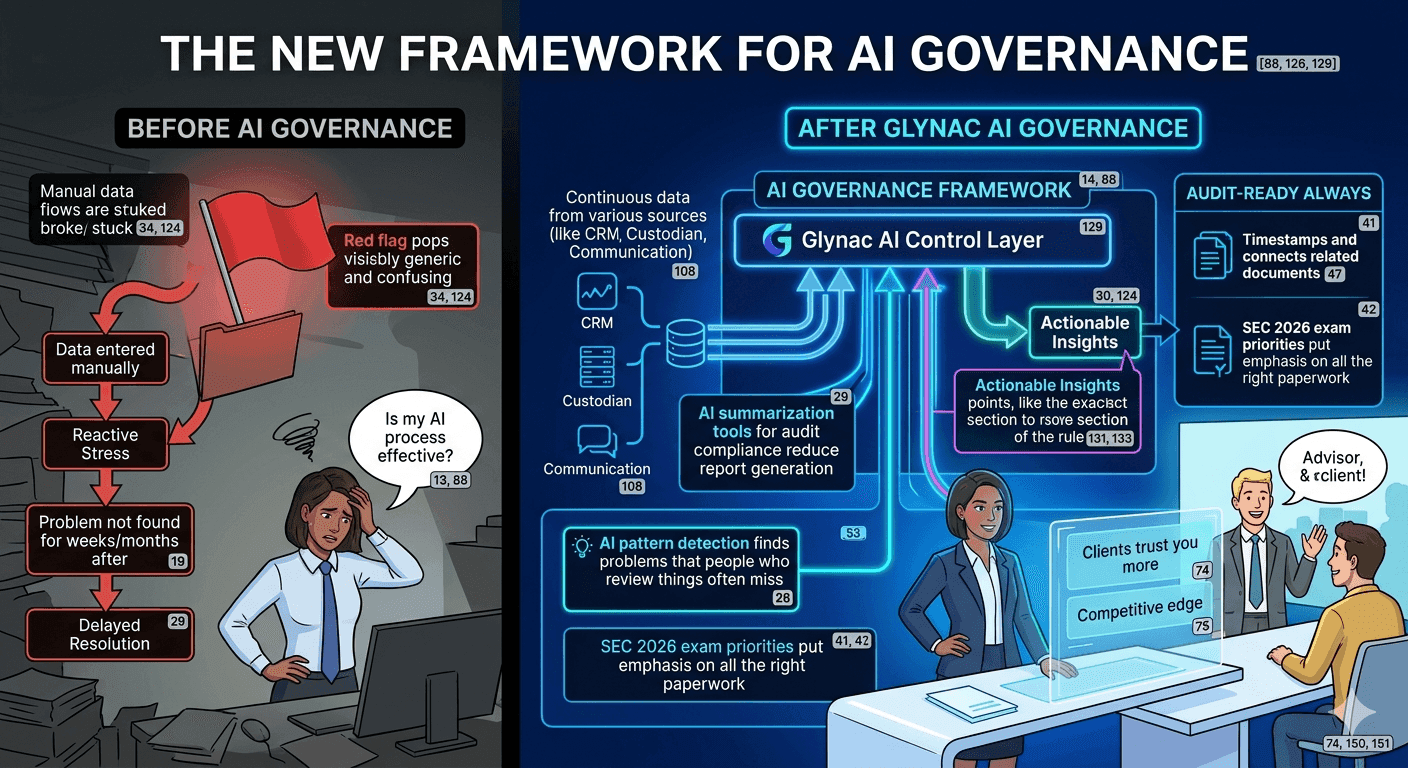
Most platforms on this list start from portfolio or CRM. Glynac starts from supervision. It runs as a wealth management AI platform for RIAs that sits over your existing systems rather than replacing them, pulling compliance-relevant information out of CRM, email, filings and portfolio data into one place a reviewer can work in.
What that looks like day to day: anomalies surfaced for a second look, communications and documents reviewed at volume, timelines rebuilt without manual digging, every finding tied back to its source record, and audit trails that accumulate instead of being assembled the week before an exam.
Among the AI platforms for investment advisors listed here, it's the one built around supervision rather than portfolio ops. Consider it if audit readiness is the pain.
Orion bundles portfolio management, reporting, CRM, planning, trading and compliance, with its Denali AI layer threaded across the ecosystem. The pitch is breadth: AI embedded in workflows you already use rather than bolted alongside them.
Best fit for firms that want fewer vendors and are comfortable consolidating onto one platform's opinion of how advisory work should flow.
Tamarac covers portfolio management, trading, reporting, CRM and client workflows, and Envestnet has been building out Decision Intelligence, applying machine learning and predictive analytics to next-best-action prompts for advisors.
Strong option for firms past the scrappy stage that want AI reading their portfolio and client data rather than running beside it.
Wealthbox has pushed past straight CRM with an AI Assistant and AI Notetaker, handling meeting prep, follow-ups, note-taking, task triage and flagging what needs attention across your pipeline.
For smaller and growing RIAs this is often the pragmatic move. Making the CRM smarter beats standing up a separate AI platform nobody has time to configure.
Jump's AI Associate goes further than summarizing. With approval, it takes action across meetings, email, CRM and planning systems: updating records, drafting client communications, creating follow-up tasks.
Useful where the drag is administrative rather than analytical.
| Platform | Best for | Key strength |
|---|---|---|
| Glynac | Compliance-focused RIAs | AI compliance intelligence and audit trails |
| Orion | Consolidating the stack | Integrated AI across wealthtech |
| Envestnet | Tamarac | Established RIA operations |
| Wealthbox | Advisor CRM workflows | AI built into daily CRM use |
| Jump | Advisor productivity | AI that executes, not just summarizes |
These aren't substitutes for each other. Plenty of firms run one as the core platform and another for a specialized job, which is a perfectly sensible outcome rather than a failure to decide.
AI can draft the client email. It cannot be the one who signs off on it.
The sequence that survives an exam is fairly simple. The tool identifies something and explains why, an advisor or compliance officer reviews it, a person decides, and the system records the whole chain. That matters most exactly where firms are keenest to deploy AI: client communications, investment-related insights, supervision.
NIST puts the principle about as concisely as anyone has:
"Trustworthy AI depends upon accountability. Accountability presupposes transparency." — NIST AI Risk Management Framework
Advisors seem to agree, incidentally. The same Advisor360° research found 90% don't expect AI to make their role obsolete over the next decade, and 69% expect advisors to stay essential with responsibilities shifting rather than disappearing. If you're choosing between RIA AI tools in 2026, the ones that make oversight easier tend to age better than the ones that route around it.
The best wealth management AI platforms for registered investment advisors in 2026 depend entirely on which problem is costing you the most. Glynac for compliance intelligence and supervision. Orion for consolidating a scattered stack. Tamarac for established portfolio operations. Wealthbox for CRM-level intelligence. Jump for taking administrative work off advisors.
What separates a good decision from an expensive one has little to do with feature counts. It's whether the thing connects to what you already run, solves a problem you can name, protects client data properly, and keeps a qualified person in control of anything consequential.
Curious how the compliance side would look against your actual environment? Talk to the Glynac team and bring a real scenario rather than a demo dataset.
Software that applies AI to advisory work: client management, portfolio workflows, data analysis, compliance oversight, reporting and advisor productivity. Scope varies enormously between vendors.
There's no single answer. Glynac is built around compliance intelligence, Orion around connected wealthtech, Tamarac around established RIA operations, Wealthbox around CRM, Jump around advisor workflows.
No. It absorbs tasks and surfaces information. Judgment, suitability, client relationships and final decisions stay with the advisor, and 90% of advisors surveyed by Advisor360° expect their role to persist through the next decade.
Integration with existing systems, data security, governance, whether human oversight is enforced rather than optional, workflow fit, and how the platform behaves as the firm grows.
Nirmala Royal
Marketing Research Assistant
Marketing research and content professional with a focus on SEO, industry research, and creating clear, research-driven content that helps businesses understand emerging trends and technologies.
Continue exploring insights on wealth management
Wealth Management
AI-powered compliance software is transforming risk assessment by automating monitoring, data aggregation, and workflows. Discover how modern platforms enable continuous compliance and reduce manual effort in 2026.
Rahul Sinha
Marketing Consultant

Wealth Management
RIA compliance automation helps firms move from manual, fragmented processes to continuous monitoring and audit readiness. Learn how automation reduces workload, improves accuracy, and minimizes compliance risk in 2026.
Rahul Sinha
Marketing Consultant